Rouen, in the Normandy rapeseed country, recorded 5.6mm of rain in the 30 days to 30 July against a 59.9mm baseline — 9 per cent of normal — according to Cropli's per-point weather data, which compares daily observations with 30-year baselines at monitoring points across the growing region. Seven of the eight monitored points in the belt took a third of normal or less. The eighth, Poitiers, took half.
Mean temperatures ran 2.4°C to 5.2°C above baseline, and Levet, Auxerre and Poitiers each recorded 17 days at or above 30°C.
French rapeseed is sown from mid-August into early September, and the crop depends on moisture in the top of the seedbed to germinate quickly and bulk up before autumn pest pressure arrives. Dry ground slows and scatters emergence. Difficult establishment, pest damage and the loss of crop-protection products had already driven several years of area cuts before this season, Plein Champ reported.
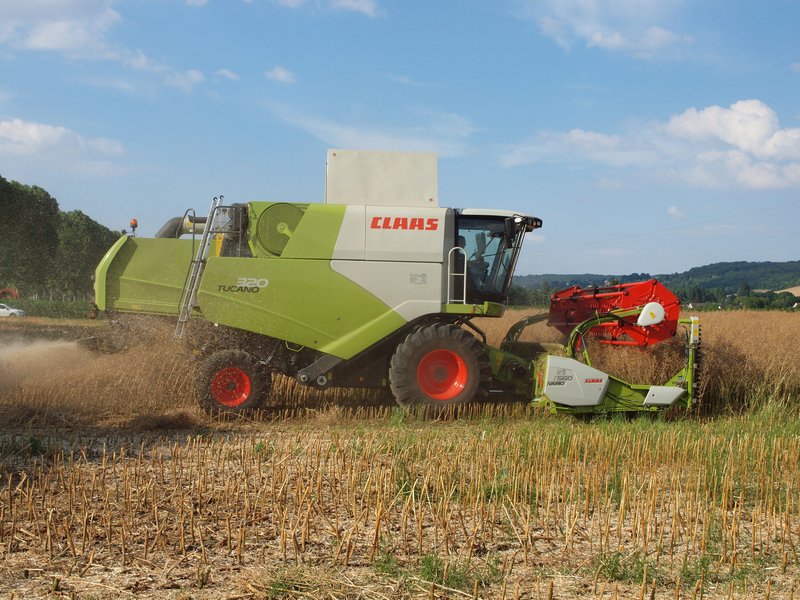
Area, not yield, carried the 2026 crop. French rapeseed yields fell by more than a tenth from 2025, with Franche-Comté down about 27 per cent and Poitou-Charentes about 17 per cent, on Agreste estimates reported by Plein Champ. Production still came in at 4.6mn tonnes, close to last year's level, because the planted area rose 12 per cent.
Price argues for repeating the bet: rapeseed delivered to French processors at Rouen was quoted at €551 a tonne in the week to 20 July, up 11 per cent from €496 in mid-April, according to price data collected by Cropli.
On Euronext, the November contract closed at €565.75 a tonne on Thursday 23 July, its highest since mid-February 2023, and Polish crushers lifted bids to a season-high 2,450 zloty a tonne, Agro Profil reported. The following day, the August contract fell 5.5 per cent to €515.75 as traders and funds liquidated long positions into expiry, while November slipped 2.2 per cent to €550.75, according to UkrAgroConsult.
Almost none of that is a rapeseed story: Brent crude passed $100 a barrel on 23 July, up about 31 per cent on the month, on blockages at the Strait of Hormuz and Bab al-Mandab and outages at Russian oil terminals; vegetable oils follow crude because they compete with it as biofuel feedstock. The US Environmental Protection Agency is raising biomass-based diesel targets, Indonesia is moving to a 50 per cent biodiesel blend and Brazil to E32. Seaborne rapeseed exports from Ukraine have virtually stopped under Russian attacks on ports and civilian vessels, UkrAgroConsult said.
"Speculative funds are rather heavily long, with very large positions," Frédéric Teissier, arable crops expert at Crédit Agricole SA, said in an interview with Pleinchamp on 21 July, translated from French. "That could constitute a downside bias if they lighten up."
Canadian producers planted a record 23.4mn acres of canola this year, up 8.4 per cent and beating the previous record set in 2017, Statistics Canada said on 30 June after surveying about 25,000 farms. Teissier put the resulting Canadian crop near last year's level at around 21.5mn tonnes. Germany, which was as dry as France during spring flowering, took between 61 per cent and 177 per cent of normal rain in July on the same Cropli data.
For French growers, the arithmetic works at current prices. Sylvain Jessionesse, a farmer in the zones intermédiaires and co-founder of the farm cash-flow tool Piloter Sa Ferme, told Plein Champ that "market conditions allow a cash surplus of more than €110 per hectare" at a yield of 3.26 tonnes per hectare.
EU rapeseed imports ran at 6.32mn tonnes in the first five months of 2026 against 6.20mn tonnes a year earlier, a rise of 1.9 per cent, on Eurostat figures accessed via Cropli. Australia remained the largest supplier at 1.79mn tonnes, down 19 per cent, while Canadian seed, much of it displaced from China during last year's tariff dispute, rose 19 per cent to 986,000 tonnes.
A third heat wave was forecast to cross Europe this week, further cutting the yield potential of soybeans and sunflowers and supporting crusher demand for rapeseed, UkrAgroConsult said on 27 July.

