The US Department of Agriculture cut its good-to-excellent rating for Illinois corn by two points to 59 per cent in the week to 16 August, even though Cropli monitoring points in the state took more than four times their normal August rain by mid-month.
Minnesota, where southern points ran at little more than a third of normal, lost five points to 66 per cent and still rated higher than Illinois. The two states are the second- and fourth-largest US corn producers, together about a quarter of the crop.
Indiana, the fifth-largest, also lost five points, to 61 per cent, while Ohio gained four. Nationally the crop slipped a point to 60 per cent good to excellent, 11 points below a year earlier.
The rain in the eastern belt was exceptional by any measure. Bloomington, in McLean County, Illinois, recorded 201.7mm of rain between 1 and 18 August against a 1991-2020 normal of 41.2mm. Only one August in 86 years was wetter across the whole month than those 18 days alone — 1993, the year of the Great Flood on the Mississippi — according to ERA5 reanalysis data accessed via Cropli. Urbana and Sheldon each took more than four times normal.
The rain fell over a dozen or more days rather than in a single flood, and temperatures stayed mild, with no Illinois point reaching 32C. Cool, wet weather during grain fill — the stage now under way, when the plant lays down starch in the kernel — usually builds yield rather than costs it.
The exception was 11 August, when a line of storms brought winds above 100mph around Portage, Valparaiso and Chesterton in Indiana, flattened corn near London, Ohio, and spawned radar-confirmed tornadoes near Chicago, Agrolatam reported.
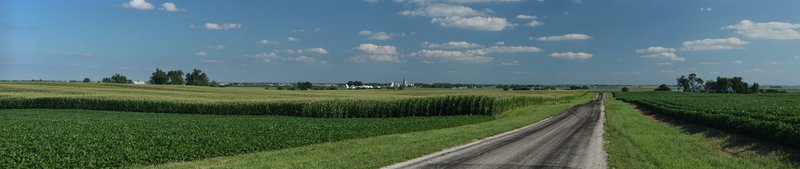
The dry north-west is where conditions deteriorated more sharply. LeSueur and Olivia, in south-central Minnesota, took 36 and 37 per cent of their normal rain over the same 18 days, each the driest first half of August in six years. The area of the state in severe drought or worse rose from 1.2 per cent in early June to 44.8 per cent by 11 August, according to the US Drought Monitor.
Southern Minnesota had been wet for most of the season, however, with the south-central corridor running at 125 to 150 per cent of normal from April to mid-August, making the August shortfall an abrupt turn rather than a summer-long drought.
The clearest measure of the split is not condition but how fast Minnesota's corn is finishing. The USDA put 82 per cent of the state's crop at the dough stage — a late step in kernel development — in the week to 16 August, against a five-year average of 63 per cent. Dented corn stood at 28 per cent, more than double the usual 13 per cent. Illinois was developing at close to its normal pace.
Not everyone reads the dry side as damaged. DTN's model, run on 1 August, put Minnesota at 200.6 bushels an acre against the USDA's 197.
Soil moisture told the same story. Ohio, which took some of the heaviest rain in the belt, went from 2 per cent topsoil surplus to 52 per cent in a single week, and Illinois rose to 25 per cent. Minnesota moved the other way, to 45 per cent short or very short.
None of it is in the number the market is trading. The USDA's 12 August forecast of 180.7 bushels an acre, which would be the second-largest US corn crop on record, came from a survey of about 14,500 growers taken between 25 July and 5 August, with a reference date of 1 August — four days before the deluge began. The agency said the forecast "will not be revised".
The USDA said its objective yield survey, the physical in-field plot counts, "will be conducted for corn, cotton, and soybeans beginning in September", meaning the headline corn figure carries no field measurements. DTN's Digital Yield Tour, a satellite and machine-learning model that is the main independent check on the survey, ran on the same 1 August snapshot and came out lower still, at 178.5 bushels.
The market has not repriced any of it. December corn slipped 1.5 cents to $4.88 a bushel on 18 August, failing to close above the July high near $4.92, and Monday's condition ratings were in line with expectations, according to Total Farm Marketing by Stewart-Peterson.
Demand is the number that is moving. Corn export inspections reached 3.187bn bushels by 13 August, up 26 per cent on last year, a pace that could push the USDA to raise its export forecast in September.
Whether the rain helped or hurt remains unsettled. Michael Cordonnier, a crop consultant who cut his own US corn estimate by a bushel to 180.0 bushels an acre on 18 August, called the week's weather a "double-edged sword".
"Even in the eastern Corn Belt, if the rainfall was not excessive, several inches of rain in mid-August is beneficial for yields," he said. "So, the question is, does the good outweigh the bad, or vice versa."
The bear case rests on nitrogen, which waterlogged soil loses through denitrification. Scouts on the Pro Farmer Crop Tour, walking the belt this week, warned that flooded Illinois fields might finish short of it.
"I think, for the most part, any time soils are saturated it hurts microbial life," Missy Bauer, an agronomist at B&M Consulting, said on the tour's livestream on 18 August.
Iowa State University modellers had disagreed before the rain fell. "Soils have sufficient nitrogen for high corn yields," Sotirios Archontoulis and colleagues wrote on 24 July. "Large amounts of nitrogen currently reside in the subsoil."
The tour's numbers were below last year everywhere it had been. Ohio came in at 180.2 bushels an acre against 185.7 in 2025, Indiana at 183.5 against 193.8, Nebraska at 163.6 and South Dakota at 149.1. Illinois posts after 8pm Central on Wednesday, against 199.6 bushels last year, with Minnesota and Iowa to follow on Thursday, when the tour publishes its national estimate.
The USDA's September Crop Production report will be the first of the season to count the corn crop in the field rather than ask growers what they expect.

