The US Department of Agriculture forecasts India's milk production will grow just 2% annually through 2026, reaching 221.4 million tonnes - significantly slower than historical rates and the weakest growth pace in over a decade.
The slowdown marks a sharp deceleration from recent performance. Milk production grew 3.78% to reach 239.3 million tonnes in 2023-24, down from 4.3% the previous year and well below the 5-6% annual growth rates achieved during much of the past decade, according to India's Department of Animal Husbandry and Dairying.
The country's herd-driven growth strategy now confronts multiple challenges, with productivity levels remaining far below global standards despite government breeding programs.
"Growth in milk production during the past few decades was primarily achieved through increase in the size of national herds of cattle and buffaloes with a modest improvement in productivity," researchers wrote in a recent paper in the journal Theriogenology. "However, such animal numbers-based growth in milk production cannot be sustained."
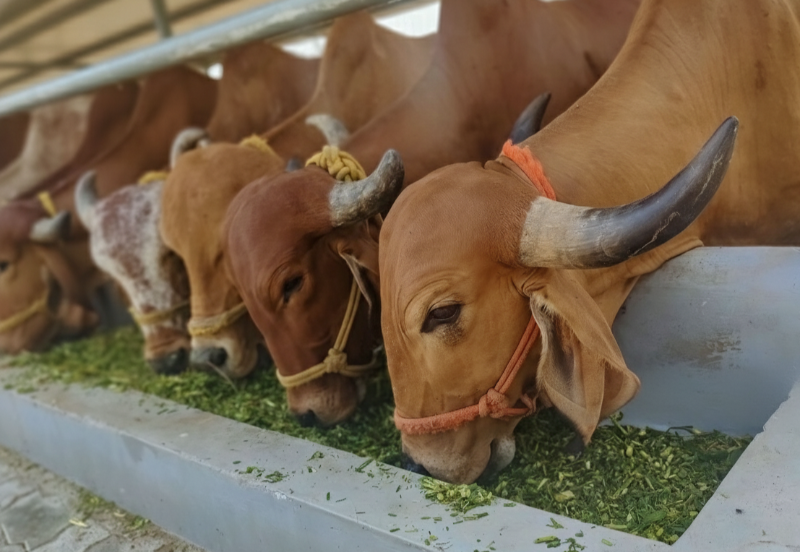
The number of milking animals grew 33% to 111.76 million head over the past decade, but that pace appears to be moderating as available grazing land shrinks and urban expansion encroaches on rural dairy operations.
Daily output per cow remains modest. Despite bovine productivity growth of 25% over the past decade - described by the government as "the best in the world" - crossbred cattle yield averaged only 8.35 kg per day in 2023-24, while indigenous cows produced just 4.20 kg daily, government data shows.
By comparison, dairy cows in the US average more than 30 kg per day. Even India's most productive crossbred cattle achieve less than one-third of US levels.
Feed and fodder costs, which account for 60-70% of milk production expenses, remain a persistent challenge. While favorable monsoons this year helped stabilize feed prices, analysts warn that climate variability and limited fodder production capacity constrain further expansion.
Buffalo milk production, which accounts for 45% of India's total output, also grew just 1.1% in 2023-24, highlighting vulnerabilities in production systems heavily reliant on water buffalo, according to industry publication Dairy Dimension.
"Future milk production growth likely depends on the continued expansion of the size and productivity of the crossbred cattle and water buffalo milking herds," the USDA's Economic Research Service noted in an analysis of India's dairy sector.
The production constraints come as domestic demand continues climbing. Per capita milk availability reached 471 grams per day in 2023-24, above the global average of 329 grams, but consumption is expected to keep rising with population growth, urbanization and increasing incomes.
The government has launched initiatives to accelerate genetic improvement through in-vitro fertilization technology and sex-sorted semen to produce more female calves, but these programs are still in early stages.
Any transformation will need to be in partnership with India's huge dairy co-operatives, which control roughly 56% of organized milk procurement.
The Gujarat Cooperative Milk Marketing Federation, which markets products under the Amul brand, is the world's largest dairy cooperative with annual turnover of $7.3 billion and 3.64 million farmer members. Other state-level cooperative federations include Karnataka's Nandini and Mother Dairy.
More innovation may come from private companies, which account for a larger share of India's milk processing capacity. In January of this year, Hatsun acquired Milk Mantra Dairy for $26 million to expand in eastern India. The deal was described by the company as a "natural progression of our vision to scale our impact and innovation across a broader market."

