Each restriction is a hands-off-flow condition attached to an abstraction licence, obliging the holder to stop pumping once river flow falls below a trigger level. The trigger is hydrological rather than agronomic, so the licence closes when the river is low, which in a dry summer is when the crop needs the water.
The Environment Agency's weekly reports record the escalation: 729 restrictions in force in the week to 7 July, 1,327 a week later, 1,353 in the week to 23 July and 1,506 by the declaration. Farm irrigation reservoirs are 30 to 50 per cent full where abstractors depend heavily on storage, the agency said on 16 July. England had received 7 per cent of its long-term average July rainfall by the date of the declaration, and 1 per cent across southern England.
Each of Cropli's six monitoring points across the sugar-beet belt — Wissington, March, Bury St Edmunds, Spalding, Newark-on-Trent and Cantley — recorded less rain over the first 29 days of July than fell in any complete July between 1940 and 2025. Wissington took 1.8mm against a previous low of 9.3mm set in 1952, and March 2.0mm against 6.2mm, on a July mean across the points of 55mm to 60mm.
The readings are ERA5 reanalysis rather than Met Office station records, and 29 days are being set against full months. Even so, this July is running five to ten times drier than 2018 and 2022, the two droughts that visibly cut the British beet crop.
The Environment Agency's weekly reporting names cereals, livestock and forage. "Farmers are harvesting crops early in the season and it is likely that there will be poorer yields with some crops such as cereals," it wrote in its report for the week to 23 July. Sugar beet and potatoes do not appear.
Beet is at early bulking, the phase in which the plant moves carbon into the storage root. Cropli's crop-stress model scores all six points extreme, attaching restricted leaf development and impaired carbon allocation to the root. Evapotranspiration at the points is running at 128 to 143 per cent of normal while rainfall runs at 3 to 8 per cent.
Sugar beet is "generally quite resilient to drought", the National Farmers' Union said on the day of the declaration, but the dry period "has put the crop under increased stress which has in turn impacted emergence, development and yield". A lack of moisture "may lead growers to consider irrigation, which adds to the cost of production and is only possible where water is available".
UK sugar-beet yield fell to 66.5 tonnes per hectare in the 2018 drought from 80.3 the year before, and to 63.9 tonnes in 2022 from 81.1 in 2021, according to FAO data accessed via Cropli — declines of 17 and 21 per cent. Applied to the 102,389 hectares harvested in 2024, a comparable hit is a swing of about 1.5mn tonnes of beet.
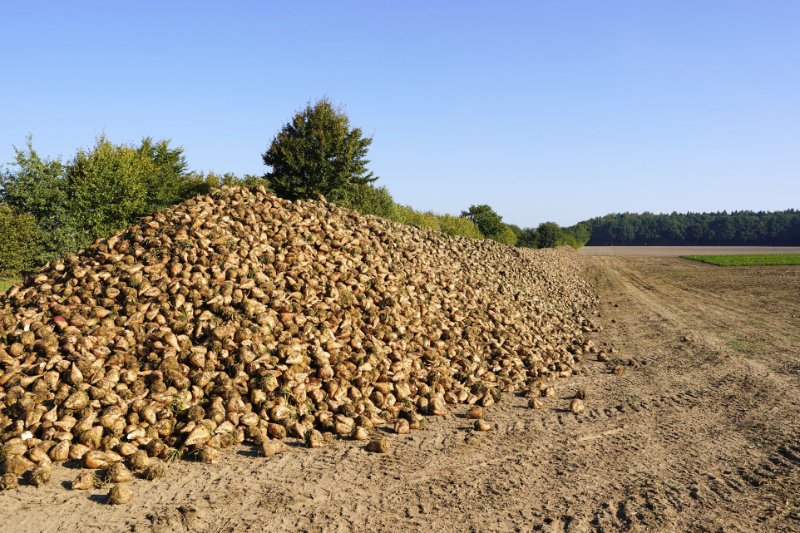
Growers meet that risk on a price already reduced: the 2026/27 contract agreed by NFU Sugar and British Sugar last August set a fixed price of £30 a tonne for up to 65 per cent of contract, against £33 for up to 70 per cent the season before, with yield protection available at a £1/t reduction. Talks on the 2027/28 contract open with this campaign as their backdrop.
At the Potato Industry Growth Summit in London this month, GB Potatoes said water should be treated as a strategic requirement for food production, and that shortages during tuber bulking cut yield, size and quality at once. "Water is not an optional extra for potato production," chief executive Scott Walker said, according to FreshPlaza. British-grown potatoes met 71 per cent of UK demand in 2025 against 90 per cent at the turn of the century, and FAO data show planted area down 19 per cent since 2017.
Growers who can buy their way out are doing so: the Elveden Estate near Thetford completed a $4.1mn reservoir last year and holds an irrigation licence covering close to three million cubic metres a year. "Water, for me, is becoming the new gold in this warming climate," Nick Scantlebury, its senior farms manager, told FreshPlaza in May.
Cropli's 16-day forecast brings rain to the beet belt in the first days of August, enough to lift all six points out of extreme stress by 8 August. At Wissington and March, the driest two, 30-day rainfall would still stand at 16mm and 20mm on 13 August, about a third of a normal July.
There is "currently little sign of the widespread, sustained rainfall that would be needed to make a significant difference to the areas most affected by the dry weather", Will Lang, chief meteorologist at the Met Office, said on 29 July. The National Drought Group meets again on 18 August.

