The Singapore Exchange's January TSR20 block-rubber contract rose 2.5 per cent to 263.1 US cents a kg on 9 October, after touching its highest since 10 May 2013 earlier in the session, Reuters reported.
Shanghai's January natural rubber contract rose 2.89 per cent the same day to 20,645 yuan ($3,083) a tonne, after touching its highest in nine years during the session, Reuters and the China Times reported. In Kuala Lumpur, SMR20, Malaysia's standard block-rubber grade, rose to 1,061 sen (about 260 US cents) a kg, its highest since May 2012, according to Bernama.
The most-active butadiene rubber contract, a synthetic used in tyres, ended the day nearly a fifth below natural rubber, at 16,880 yuan for November delivery. Six months earlier the order was reversed: butadiene rubber hit an all-time high on 23 March, and the next day its May contract traded above natural rubber.
That was when the case for substitution was made. High butadiene rubber prices were supporting natural rubber through substitution, Tianfeng Futures said in a report on 24 March, Reuters reported.
In May, Kosol Boonkong, then acting governor of the Rubber Authority of Thailand, told Thansettakij that the war had pushed part of the market towards synthetic. By late June he said tyre makers had begun turning to cheaper natural rubber.
His colleague Ditdech Wattanaporn told Khaosod in late June that some manufacturers that had switched to natural rubber had gone back to synthetic as crude fell to about $60 a barrel.
Tyre makers' own filings point to a cost spike rather than a switch. Styrene-butadiene and butadiene rubber prices "surged sharply in the short term, then fell back somewhat" in the first half, Sailun Group said in its half-year report on 30 August.
Toyo Tire said in May that part of the rise it expected in its natural rubber costs this year was a "knock-on effect from rising synthetic rubber prices".
Not everyone dismisses the link. The International Rubber Study Group listed "elevated crude oil and synthetic rubber prices" among the drivers of the rally in a report released on 2 October, alongside tight supply, stronger consumption and the weather.
"Elevated oil and petrochemical feedstock prices can support synthetic rubber prices and reduce substitution pressure on NR," the group said.
The rally also predates the war. The World Bank's monthly average for RSS3, the benchmark Thai export-grade smoked sheet, rose 11 per cent between November and February, before the conflict broke out on 28 February, according to data accessed via Cropli.
RSS3 peaked in June at its highest since May 2013, and TSR20 averaged 241 cents in September, its highest since September 2013. Rubber fell with other commodities in March as the conflict hit markets, China Hainan Rubber Industry Group said in its half-year report.
Since the conflict began, the correlation between Brent crude and TSR20 has turned negative, at minus 0.22, MBS Research in Hanoi calculated on 16 September.
SUPPLY TIGHTENS, STOCKS FALL
The Association of Natural Rubber Producing Countries (ANRPC) on 30 September cut its forecast for world output this year to 15.039mn tonnes from 15.279mn tonnes a month earlier, still 0.6 per cent above 2025. It revised estimates for Thailand, Malaysia and Indonesia, and for Thailand's output last year.
World production fell 4.2 per cent to 8.68mn tonnes in the first eight months of the year, while consumption fell 2.7 per cent to 9.89mn tonnes, the association said.
"Production was affected by weather conditions, especially erratic rainfall and drier conditions that prevailed across Southeast Asia," ANRPC Secretary-General Suttipong Angthong wrote in the report. The association left its demand forecast unchanged, putting forecast consumption about 317,000 tonnes above output.
Indonesia's natural rubber exports fell 21 per cent to 864,000 tonnes in the first eight months of the year, according to Qinrex data cited by Reuters. Congestion at Abidjan port in Ivory Coast, one of the three largest producers, has added to supply concerns, a Singapore-based trader told Reuters.
China's natural rubber inventories fell 20 per cent in the first half, to 1.298mn tonnes, Hainan Rubber said. Stocks in Qingdao, a major trading and storage hub, fell to 575,200 tonnes in the week to 27 September, according to Longzhong Information data cited by Reuters.
Fu Xinxiang, who runs a futures delivery warehouse in Qingdao, told the state-run Economic Daily that his company held about 90,000 tonnes of rubber there, against about 150,000 tonnes in previous years. Commodity funds and speculators bought an estimated 300,000 tonnes of rubber futures on the two Shanghai exchanges in the week to 25 September, Japan Exchange Group said.
Not all analysts see a shortage. "High rubber prices are driven by inventory accumulation among processing plants and concerns over supply disruption, rather than reflecting supply shortage," MBS said, adding that profit margins were encouraging growers to start tapping trees for latex earlier.
China's rubber imports and domestic output "have not fallen noticeably", and the price rise is "more a reflection of expectations", industry participants told the Economic Observer.
Demand offers the rally little support. World consumption in the first half was 1.3 per cent lower, Hainan Rubber said, citing ANRPC data. Chinese car- and truck-tyre plants ran below 30 per cent of capacity on 8 October, during the National Day holiday, down from 46.4 per cent and 39.0 per cent a week earlier, according to Qinrex data cited by Reuters.
Tyre makers are trying to pass the costs on. More than 60 Chinese manufacturers have issued more than 70 letters announcing price rises since September, mostly of 2 to 5 per cent, the Economic Daily reported.
Prices of carbon black, a filler that strengthens tyres, have risen more than 75 per cent and synthetic rubber 15 to 20 per cent, Wang Xiaocai, sales director at Shandong Huasheng Rubber, told the paper. In August the most common all-steel truck tyre sold wholesale for about 909 yuan, below the roughly 989 yuan it cost to make, the Economic Observer reported.
FLOODS IN THE EAST, DRY AUGUST IN THE SOUTH
Brokers have also blamed rain for disrupting tapping in Thailand, the world's largest producer. Floods hit 42 provinces and killed at least 23 people between 16 and 29 September, concentrated in central, eastern and northeastern Thailand, according to the interior ministry.
A 29 September government list of flooded provinces included the eastern rubber provinces of Chanthaburi, Rayong and Trat but none in the south, The Nation reported. The meteorological department did report flooding in Narathiwat, on the Malaysian border, on 25 and 26 September.
The Rubber Authority of Thailand counted 141,472 rai (22,636 hectares) of rubber plantations flooded in the eastern provinces of Rayong, Chanthaburi, Chachoengsao and Sa Kaeo between 24 and 30 September, affecting 7,679 growers, acting governor Sansana Suriyayothin said, Daily News reported on 6 October.
That is about 0.6 per cent of the 23.8mn rai Thailand has under rubber, on agriculture ministry figures cited by MBS. As of 11 October floods still affected 3.14mn people in 21 provinces and Bangkok, led by central and eastern provinces, the Department of Disaster Prevention and Mitigation said.
In the south, August was dry. Rainfall was the lowest for the month since at least 1991 at six of 14 monitoring points across southern Thailand, and among the four lowest at all 14, according to ERA5 reanalysis data accessed via Cropli.
September was wetter but not exceptional: rain on the Gulf of Thailand coast ran above normal at all eight monitored points, a record at none, with Saba Yoi in Songkhla province recording its second-wettest September since 1991. The wet spell then faded, with rain below normal at six of the eight points from 27 September to 6 October – 57 per cent of normal in Surat Thani and 49 per cent in Don Sak.
Brokers read the weather differently. Rain in producing regions has been persistent and heavy and is expected to continue until mid-October, Everbright Futures said on 9 October, according to Reuters. Ruida Futures said rainfall in southern Thailand had fallen as El Niño developed, and that output tends to fall three to six months after a drought, Shanghai Securities News reported.
High prices may also bring more rubber out. The International Rubber Study Group puts world output at about 19.6mn tonnes if all mature trees were tapped, against roughly 15.1mn tonnes now, and said attractive prices "could raise NR supply relatively quickly".
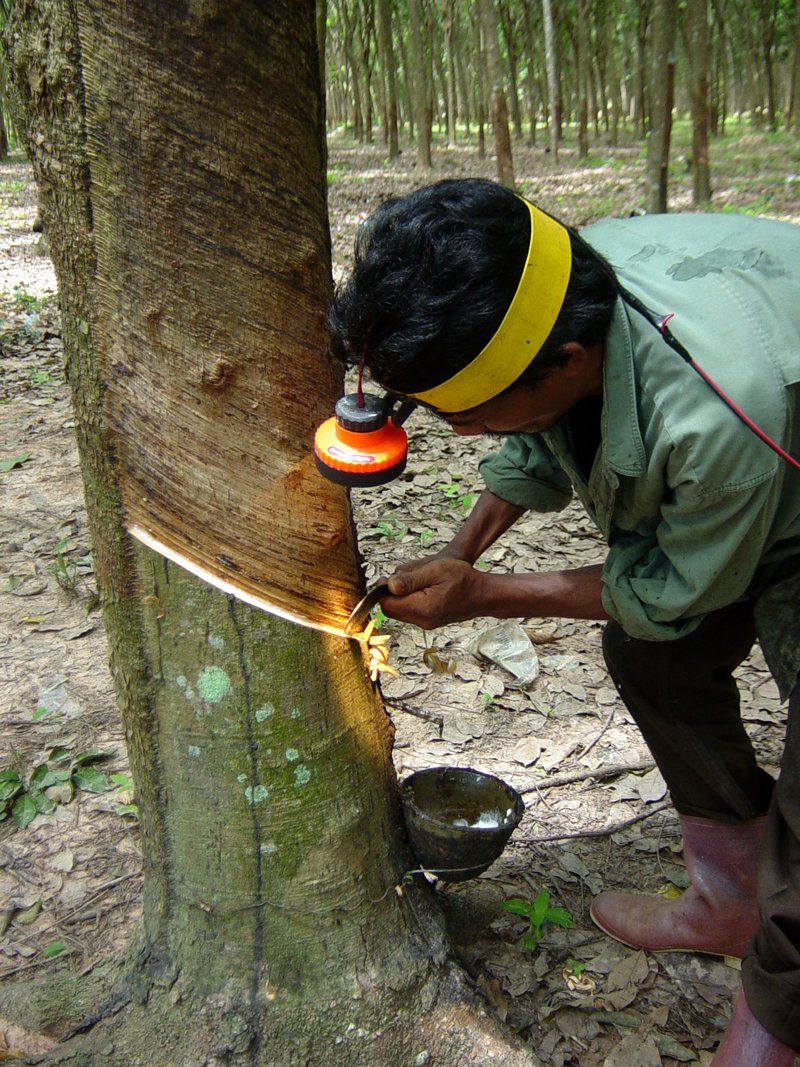
In Xishuangbanna, in China's Yunnan province, tapper Yang Qinghua told the Economic Daily that a day's tapping of 600 trees now earned him more than 500 yuan, against just over 300 yuan a few years ago, and that people who had left to work elsewhere had "basically all come back to tap".
Thailand's meteorological department has forecast heavy rain in parts of the south until 17 October, with very heavy falls in Surat Thani and Nakhon Si Thammarat on 11 October. The ensemble forecast of the European Centre for Medium-Range Weather Forecasts puts median rainfall at four Gulf-coast points over 12 to 26 October at 64 to 95 per cent of the 2017–2025 average, according to data accessed via Cropli.
The World Meteorological Organization said on 8 October that El Niño would strengthen before peaking in December and was nearly certain to last until February 2027.

