The world's largest tomato paste exporter is aggressively courting buyers in the Caribbean, Central America and South America after losing ground in Europe, a traditional market stronghold.
"China has turned its attention to South America, Central America, and the Caribbean where its sales are increasing," Martin Stillwell, an industry analyst, told the Tomato News Conference last month in Cologne, Germany.
While volumes remain small, China has made significant inroads in Caribbean nations and countries like Panama and El Salvador. Mexico has proven more resistant.
The expansion directly threatens US processors who have long viewed Latin America as their natural market. California ships about 30% of its exports to the region alongside dominant sales to Canada.
Chinese exports slipped 4% to 1.2 million tonnes in 2024 from a record 1.25 million the previous year. But the real pressure comes from collapsing prices -- down nearly 40% from $1,170 per tonne in late 2023 to just $710/t by September this year.
"China has been hit very hard by its decreasing ability to sell into Europe, and it's therefore been forced to look for other markets," Stillwell said in a question-and-answer session in Cologne.
European sales declined amid pressure over reported labor issues in Xinjiang province and preference towards Italian product.
California may be well-positioned to fight back. The state just experienced a "unicorn season" with yields surging over 10% due to ideal weather. It produced nearly an extra million tonnes despite reduced acreage.
A weakening US dollar under the current Republican administration would boost competitiveness further, Stillwell said. "That makes California already a formidable competitor, and more competitive."
Chile has also ramped up production and sales to both South America and Europe.
China's Latin American push mirrors its domination of Africa. China exported 83,271 tonnes of tomato paste to Ghana in 2024, making it the third-largest market. Nigeria took 67,838 tonnes. Combined with other African nations, the continent is now China's biggest regional customer.
"Chinese exporters dominate the African continent" and "very few other countries manage now to export to Africa," Stillwell said.
Southeast Asia tells a similar story. The Philippines now buys "almost exclusively from China."
Industry executives questioned whether the Latin American expansion represents long-term strategy or just an attempt to clear oversupply from 2024's massive crop, which hit around 11 million tonnes -- nearly 30% above typical levels.
Stillwell suggested both factors are at play. He noted China's domestic market is growing but is unable to absorb the surplus above 7 million tonnes based on historical averages. "Beyond that, China has to have additional exports in order to be able to balance its inventories," he said.
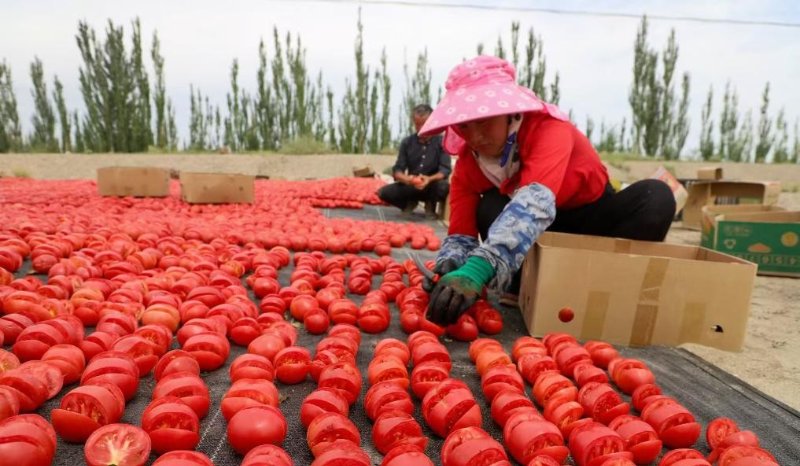
A Chinese company representative at the World Processing Tomato Council meeting before the conference forecast production would rise from 6 million to 7 million tonnes next year. Processors want to rebalance after cutting operating companies from 109 to 52 this year.
"The Chinese industry is now an industry which has been in place for a long time. The problems which it had originally, with many quality problems, have to some extent been resolved," Stillwell said.
The global tomato processing industry faces a supply glut. Production needs to fall by 4 million tonnes next year to balance markets after cutting 4 million this year, Stillwell estimates.
Iran has also emerged as a major force, capturing Middle Eastern markets. It means Iran and China together have replaced European and North American suppliers in countries like Russia following geopolitical realignments.

