Exports to Saudi Arabia, Oman and Jordan, whose cargo enters through Jeddah, Salalah, Sohar and Aqaba without passing through the strait, rose 1 per cent over the same six months, according to Eurostat figures accessed via Cropli.
Across six food lines - cheese, apples and pears, poultry, potatoes, citrus and tomatoes - the EU shipped 51,916 tonnes to the United Arab Emirates, Qatar, Kuwait, Bahrain, Iraq and Iran in the first six months of 2026, down from 70,486 tonnes a year earlier.
Shipments to the three markets outside the strait rose to 131,184 tonnes from 118,592 tonnes.
For all nine markets combined, exports fell 11.9 per cent by value to €431.8mn, about $503.9mn, from €489.9mn, about $535.4mn, and 3.2 per cent by volume, a total that masks the divergence.
Saudi Arabia accounts for all of the growth outside the strait and runs its own food-security programmes, while Iraq and Iran, inside it, fell 36.6 per cent under sanctions and war conditions that are not only logistical.
Excluding all three, exports to Oman and Jordan still fell 14.1 per cent by value, against 24.5 per cent for the UAE, Qatar, Kuwait and Bahrain.
REEFER BOOKINGS SUSPENDED
The trade data end before a suspension of refrigerated cargo by one of the world's largest shipping company.
In its Middle East Operational Update 44, published on 31 August, global shipping giant Maersk suspended refrigerated bookings to and from Iraq, Kuwait, Qatar, Bahrain, Jordan, Saudi Arabia's Dammam, Al Jubail and King Abdullah ports, and the UAE excluding Khor Fakkan and Jebel Ali.
The only Gulf-region ports it listed as still accepting reefer bookings were Oman's Salalah and Sohar, and Khor Fakkan in the UAE for imports only, all three reachable without entering the strait.
Jebel Ali, the largest container port in the Middle East, is exempted only for boxes trucked in from Khor Fakkan or Fujairah.
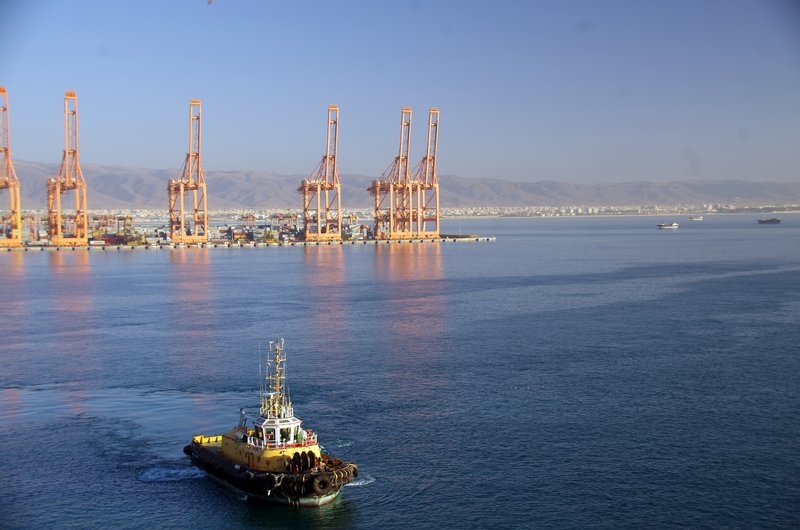
Dry containers are still moving to several of the same markets. The advisory suspends dry bookings only for the rest of the UAE, Iraq, Dammam and Al Jubail, and accepts them to and from ten others, including Kuwait, Qatar, Bahrain and Jordan.
Maersk also added an emergency freight rate on cargo loading from or bound for Iraq, Kuwait, Bahrain, Qatar, the UAE, Oman other than Salalah, and Dammam and Jubail, of $1,800 a 20-foot dry container, $3,000 a 40-foot dry container and $3,800 for reefer, special and dangerous-goods boxes.
A further $1,000 a container applies on any vessel transiting the strait, to cover "insurance premiums and crew risk compensation", and storage beyond a 14-day allowance costs $25 per TEU, or 20-foot container equivalent, a day.
The rerouting the rate pays for is already in place. Upper-Gulf cargo is transhipped through Salalah and Khor Fakkan and trucked by landbridge to Sharjah, and Saudi cargo for Riyadh and Dammam moves on what Maersk calls "the established Jeddah Landbridge solution".
The company has issued two further Middle East updates since, on 9 and 11 September, and on 11 September announced a separate emergency operational cost recovery surcharge on cargo to Bahrain, Qatar, Kuwait and Iraq from everywhere but the Far East.
"Shipments that contain critical foodstuff, medicine and perishable goods, we will do our utmost to ensure special attention is given," the company said in the advisory.
STRAIT SHUT SINCE FEBRUARY
The Strait of Hormuz has been effectively closed since 28 February, when US-Israeli airstrikes prompted Iran's Revolutionary Guard to declare it shut.
Seven vessels transited on 9 September against a 10-day average of 14, according to Reuters figures reported by WorldCargo News.
The United States said on 8 September it had destroyed five Iranian oil tankers after missile attacks on a US Navy warship. Iran said the next day it had attacked ten vessels near the strait.
Roughly 80 per cent of the UAE's agricultural products are imported, the US Department of Agriculture's Foreign Agricultural Service said in reports published in July and August, and the country's seaports received more than 60 per cent of all cargo destined for the Gulf Cooperation Council in 2025.
"Recent geopolitical developments in the region, along with the closure of the Strait of Hormuz, have severely disrupted global shipping routes, including those critical for food imports to the UAE," the agency's July exporter guide said.
It named Khor Fakkan and Fujairah as the substitute ports and a Dubai Customs "Green Corridor" with Oman as an overland route.
Air freight and overland trucking are "slower and significantly more expensive", the guide said, and hypermarkets that depend on imported goods have faced delayed shipments and higher transport and insurance costs, which it attributed to flight restrictions and the closure.
The Dubai guide credited the UAE's strategic food security framework with "up to six months of food supply coverage for key commodities" and said that had helped hold availability through the spring.
In an August report on food processing, the Dubai post said Jebel Ali's throughput had fluctuated since March because of the tensions around the strait, "affecting shipping patterns and vessel routing in the Gulf".
The port is the ninth-largest container terminal in the world at 14.47mn TEU a year, and the USDA names its cold storage among the reasons food companies handling perishables use it.
The UAE bought $17.7bn of consumer-oriented food in 2025, with the European Union among its main suppliers alongside India, Brazil, the United States, Saudi Arabia and China.
APPLES GROW, OUTSIDE THE STRAIT
Apples and pears were the only one of the six lines to grow, and all of the growth was outside the strait.
Shipments to the strait-dependent markets fell 14.1 per cent to €19.6mn, while those to Saudi Arabia, Oman and Jordan rose 40.8 per cent to €68.6mn. Saudi Arabia alone took 45,500 tonnes, up from 29,400 a year earlier.
That route is itself narrowing. Jeddah and Aqaba are Red Sea ports, and Yemen's Houthis took the port of Mocha this month and then Perim island in the Bab el-Mandeb, the channel at the southern end of the Red Sea, on straits.live's tracking.
Maersk's reefer suspension already covers Aqaba, Dammam, Al Jubail and King Abdullah. Freight volatility "continues to pressure margins for processors and foodservice operators", the USDA's Dubai post said on 4 August, citing "recent disruptions in the Strait of Hormuz and the Red Sea".
The FAO set out the thresholds in March. A disruption of up to a month would leave impacts contained, chief economist Máximo Torero told a United Nations press briefing on 26 March, while three months or longer would reach 2026 planting decisions, wheat, rice and maize yields, and substitution into nitrogen-fixing crops.
Up to 30 per cent of internationally traded fertiliser normally moves through the strait.
"This is not only an energy shock. It is a systematic shock affecting agrifood systems globally," Torero said. He named Qatar and the UAE, "huge importers of food", as facing difficulty because no vessels were reaching the region, UN News reported.
The flow in the other direction is small. EU imports of dates from the Gulf and Iran fell 22.2 per cent to €27.7mn in the first half, against the €431.8mn moving in. Iran, inside the strait, supplied €12.4mn of that.
Iran, Iraq and Gulf states met in Salalah on Monday, 14 September, to discuss a new maritime route, straits.live reports. Iran says it is not a reopening.

