At the Rungis wholesale market outside Paris, however, the summer's entire rise in the apple price has gone to the large fruit that always met the retailer's preferred grade; the small calibres, or size grades, that the retailers have just agreed to accept have barely moved.
The trade-wide commitment came on 18 August from the Fédération du commerce et de la distribution, which represents most of France's grocery chains and groups E.Leclerc, Carrefour, Auchan, Intermarché, Les Mousquetaires, Casino and Coopérative U. The federation said its members would take a more pragmatic approach to acceptance conditions, including size and appearance, and give priority to French origin, according to Agence France-Presse. It followed a public call from farm minister Annie Genevard for the trade to accept less perfectly calibrated produce.
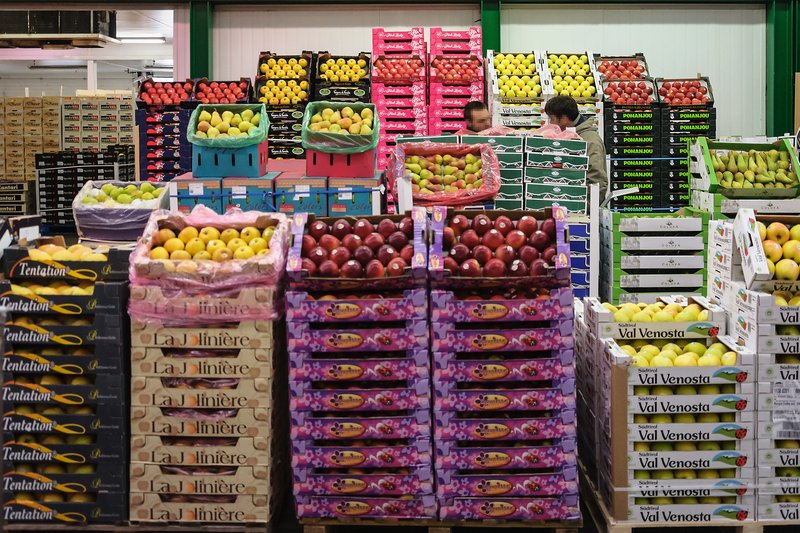
Carrefour and Coopérative U had each moved on 14 August. Carrefour said it would relax its buying criteria on weight, size and visual appearance, the trade outlet FreshPlaza reported. It would also shorten payment terms to 15 days for one month and waive penalties on farmers hit by logistical or supply difficulties, FreshPlaza said. Neither retailer promised to hold the price. Carrefour's commitment on purchase prices is a conditional pass-through of higher production costs, not a guarantee, and neither named a crop, a size or an end date for the spec relief.
However, Rungis wholesale market prices show a rising premium for larger-sized fruit as shortages bite. French Golden Delicious apples in the 201/270-gram grade were quoted at €2.20 a kilo over the first 17 days of August, up 27.2 per cent on the same period last year, according to FranceAgriMer's RNM market assessments analysed by Cropli. The smaller 170/220-gram grade — the fruit the relaxed specifications are meant to rescue — was quoted at €1.49, down 0.6 per cent.
The gap between the two quotations widened to €0.71 a kilo, the widest in absolute terms in the nine Augusts for which both were quoted, and more than three times last year's.
The large-grade quotation stepped up from €1.60 to €2.00 on 16 July and to €2.20 on 23 July, three weeks before the first supermarket announcement, and has held since.
The pattern is sharpest in pears, where Rungis quotes one variety across adjacent size bands. On 17 August the early pear Guyot was quoted at €1.90 a kilo for French Class I fruit of 60 to 65 millimetres, against €2.30 for the same fruit at 70 to 75 millimetres. That is a 17 per cent discount for being about 10 millimetres smaller, on the same day and in the same packaging. WAPA, the World Apple and Pear Association, puts this year's Guyot crop down 23.6 per cent.
None of the fruit taking that discount is too small to sell legally. The EU marketing standards rewritten in 2023, in force since January 2025, set the minimum apple at 90 grams, and let fruit down to 70 grams through if it reaches 10.5 degrees Brix — a threshold drought-stressed fruit tends to clear. The smaller of the two Golden grades, at 170 to 220 grams, is nearly twice that floor; the Guyot pear taking the €0.40 discount is 60 to 65 millimetres against a Class I minimum of 50 millimetres.
French producer bodies warned of the discrepancy before the retailers moved. In a submission to the ministry reported on 3 July, six weeks before Carrefour's announcement, four of them warned that widespread calibre loss cost growers twice, cutting the tonnage in the field and then the value of what was left.
"There is a growing awareness on the part of the industry, who are accepting the tolerance," said Marc Kérangueven, president of the Breton vegetable cooperative Prince de Bretagne, whose members are losing 400 tonnes of lettuce a week. "The problem for our farmers is the non-harvest," he said, speaking in French. "Even with higher prices, even very high ones, when you multiply by zero it makes zero. A price rise will never make up for the losses suffered within our producer organisation."
The scale of the shortfall is not in dispute: WAPA's Prognosfruit forecast, issued on 6 August, put the EU apple crop at 9.5mn tonnes, down 15.6 per cent and one of the smallest in a decade, with France about a quarter lower.
The ANPP, the French apple and pear producers' association, said on 18 August the national crop would fall "at least 25 per cent", translated from French. It expected smaller fruit too, saying the intense heat had blocked the swelling of the apples. At six of Cropli's seven monitored French apple points, June and July together were the warmest such pair of months in records reaching back to 1940 — the weeks when apples do most of their sizing.
Genevard meets France's prefects on 27 August to set the scale of the government's drought and heat aid for farmers. The total is due on 3 September.

