The Federal Ministry of Industry, Trade and Investment unveiled a national cashew roadmap on 15 July built around a minimum 30 per cent value-addition requirement before export. It also creates a Nigerian Cashew Project Office to be run with the agriculture ministry, the National Cashew Association of Nigeria (NCAN) and Germany's development agency GIZ.
More than 85 per cent of the crop leaves the country unprocessed, the ministry said.
But the estimates underpinning the policy diverge widely. The trade ministry puts annual output at 300,000 to 350,000 tonnes, whereas data from the Food and Agriculture Organization, accessed via Cropli, show production falling to 80,944 tonnes in 2024, down 19 per cent from a 2019 peak of 101,500 tonnes.
That places Nigeria 12th in the world, behind Guinea-Bissau and at less than a tenth of Côte d'Ivoire's 944,673 tonnes, according to the FAO series.
The gap is one of yield rather than land. Harvested area rose to 170,224 hectares in 2024 from 131,529 hectares in 2015 but has been roughly flat since 2020. The roadmap lists ageing plantations, inadequate seedlings and weak quality standards among the sector's constraints.
Industry figures are no more consistent. GuarantCo, a credit guarantor backing a new plant, cited a crop of 250,000 to 300,000 tonnes in February. NCAN president Ojo Ajanaku told local newspaper THISDAY this year that Nigeria produced 600,000 tonnes; in July the association told trade outlet FreshPlaza the figure was 350,000 tonnes.
"That is why we cannot get accurate figures of actual production," Ajanaku told THISDAY. He alleged that foreign operators bypass official export documentation to avoid repatriating foreign exchange.
EU imports of shelled Nigerian cashew, the one measured slice of the trade, rose to €20.03mn in 2025 from €8.18mn in 2022 under HS code 080132, Eurostat data accessed via Cropli show. That lifted Nigeria to seventh among the bloc's kernel suppliers for the first time, though three of the six ranked above it are EU members re-trading imported nuts.
The advance has since stalled. EU imports from Nigeria fell 35 per cent to €3.17mn in the first five months of 2026 from €4.89mn a year earlier, while imports from Côte d'Ivoire rose 34 per cent to €95.1mn.
Nigeria's raw nuts largely bypass Europe. EU imports of in-shell cashew under HS 080131 total between €6.5mn and €9mn a year and are almost entirely intra-EU re-trade, with shipments from Nigeria negligible. Trader Cardinal Torch puts the share of the national crop sent to India and Vietnam for processing at 80 per cent.
Nigeria is also losing ground on price in the Asian trade. Vietnam imported 49,507 tonnes of Nigerian raw cashews in May, worth about $79mn and down from 69,728 tonnes a year earlier, according to Vietnamese customs data reported by FreshPlaza. Côte d'Ivoire shipped 107,090 tonnes over the same month, up 93 per cent. Nigeria's export benchmark was $1,600 a tonne against Côte d'Ivoire's $960.
Processing capacity remains modest. Cardinal Torch announced a 4.5bn naira ($3.3mn) plant at Shagamu in Ogun State on 1 August, with a nameplate of 10 tonnes a day and commissioning due in the first quarter of 2027. Robust International, a Singapore-based trader, is building a plant in the same state under a $75mn facility guaranteed by GuarantCo, taking its group capacity to 220 tonnes a day from 100.
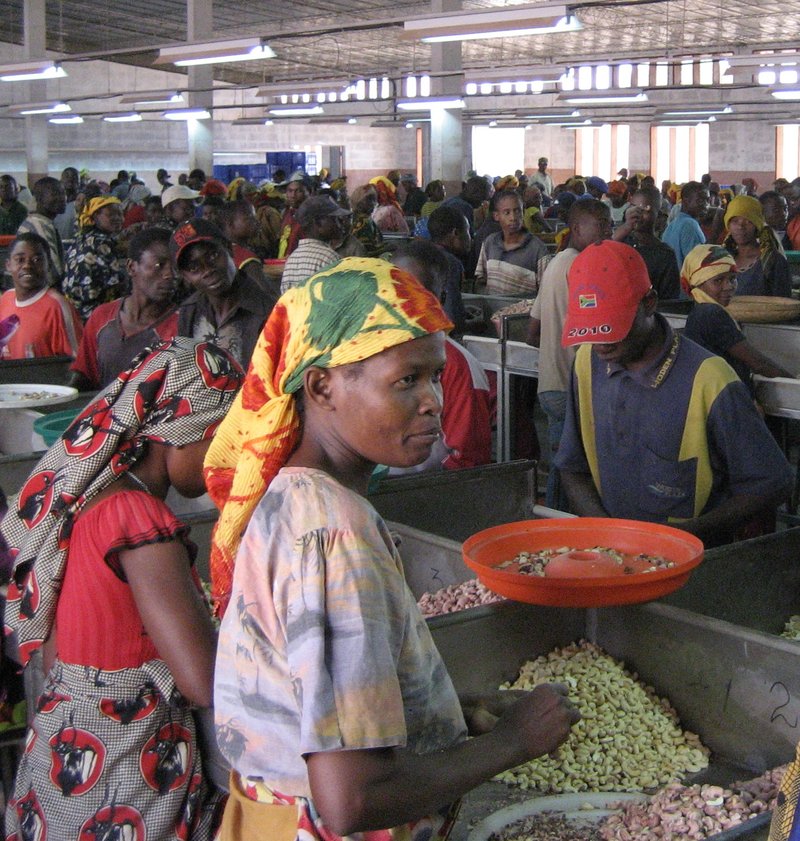
"We're moving from just exporting raw cashews to processing them locally," Cardinal Torch managing director David Olurin said at a briefing last month.
The government has already banned raw exports of other crops. Raw shea nut exports were banned in August 2025, under a measure since extended to 25 February 2027, and raw cocoa bean exports were banned in July. No comparable instrument has yet surfaced for cashew, and the 2026 Fiscal Policy Measures approved on 1 April contain no cashew provision, according to a report published by the US Department of Agriculture's Foreign Agricultural Service on 14 May.
NCAN opposes a ban. "It does not make economic sense to endanger five million livelihoods in an attempt to create 35,000 jobs," the association told THISDAY, arguing that processors borrowing at 25 to 35 per cent cannot carry stock through a harvest window of three to four months that requires up to nine months of storage.
Vietnam imported more than 3.12mn tonnes of raw cashew nuts worth over $4.67bn in 2025 and supplies as much as 80 per cent of world kernel exports, according to the Vietnam Cashew Association, which said African suppliers' export restrictions had made those purchases harder and more expensive.
No independent public series measures the crop the policy targets. The USDA's Foreign Agricultural Service, which publishes annual tree nut assessments for most major producers, has never issued one for Nigerian cashew. A search of its 22,056 published GAIN reports returns none from the country on the crop.

