Industry estimates put the crop at 600mn to 900mn lb against last year's record of about 1.6bn lb. Wonderful Pistachios, which accounts for roughly 60 per cent of the California market, said on 4 August that the fall could exceed 60 per cent — the pessimistic end of that range — and warned that retailers and consumers can expect price increases.
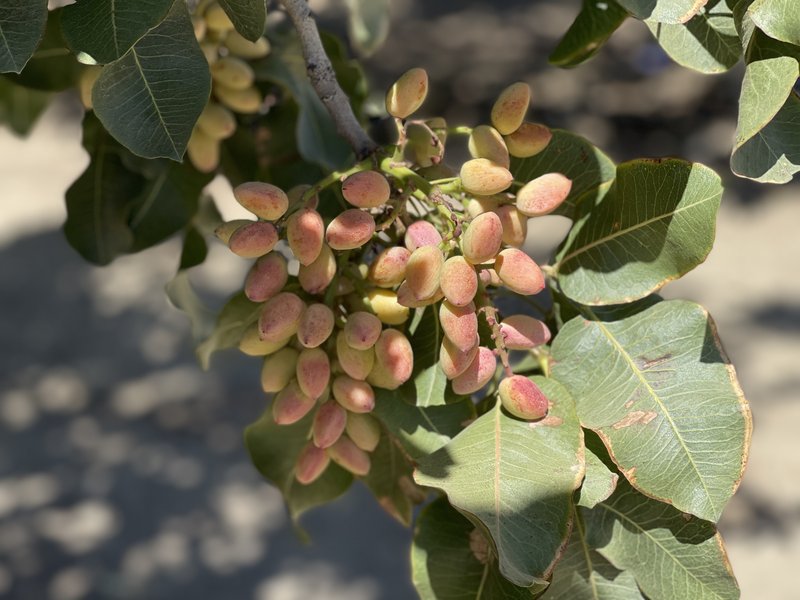
Pistachio trees alternate between heavy and light crops, and a light year was expected after last year's heaviest on record, when growers delivered 1.57bn lb, on Administrative Committee for Pistachios figures cited in trade reports. US output has dropped in seven of the past 12 years, by 27.5 per cent on average and never by more than the 47.5 per cent recorded in 2015, according to FAO data accessed via Cropli. Anything beyond 60 per cent would be the steepest decline in that record.
March 2026 was the warmest March in the 132-year contiguous US record, and California posted both its warmest and its driest March, with less than a quarter of an inch of rain statewide, according to NOAA's National Centers for Environmental Information.
Daily maximum temperatures ran 4.6C to 7.1C above the 1991-2020 normal at all seven of Cropli's monitoring points in the California pistachio belt, with 13 to 21 of the month's 31 days above the 90th percentile. Delano/Bakersfield, nearest the Kern County acreage that anchors the industry, averaged 27.9C against a previous March high of 25.7C in a series beginning in 1940. Three points set outright records; the other four came second, behind March 2015 — the year of the deepest US pistachio crop failure in the FAO record.
The heat came as a five-day spike, from 17 to 21 March: Fresno reached 90F on four days that week, matching the station's entire tally of March days above 90F over more than 140 years, and Bakersfield ran three consecutive 90F days, which local meteorologists said had never happened before in March. April, the core bloom month, then came in close to normal, running 2.4C above average at Delano/Bakersfield.
Observed bloom dates in Kern County, recorded by Craig Kallsen, emeritus pistachio advisor for the University of California Cooperative Extension there, run from 31 March to 11 April for the Golden Hills variety. On that window the heat landed before bloom rather than during it.
West Coast Nut's account is that the March temperatures brought dormancy to an early end, which pulls male and female bloom out of step in a crop that is wind-pollinated and needs three to 10 days of overlap between the two. Either route — pollen killed at bloom, or bloom desynchronised before it — ends in blank nuts. Some orchards are showing as much as 90 per cent blank nuts, AgNet West reported in July.
A 30-year study of three Kerman orchards by Kallsen found four factors explaining more than 65 per cent of yield variation. The previous year's yield ranks first; warm spring temperatures above 80F before bloom rank second.
Winter chill, too little of which broke the 2015 crop, was adequate this season: all seven points recorded more days with mean temperatures between 0C and 7.2C last winter than in either of the two preceding winters.
No official number for the crop exists yet. Wonderful is privately held and files nothing, and its estimate arrived four weeks before the US marketing year opens on 1 September. The committee, the federal marketing order covering 99.99 per cent of US production, files the monthly shipment reports the trade settles on.
"Shoppers will still see the same pistachios, at the same stores, on the same shelves," said Michael Hohmann, chief financial officer and executive vice-president of Wonderful Pistachios & Almonds, pointing to carryover from the record harvest. That carryover is going out at record pace: shipments reached 756.2mn lb in the crop year to 31 March, up 22.4 per cent, leaving marketable inventory at 598.4mn lb, according to the committee's April report.
Export prices were already climbing before this season's crop came into question: US in-shell pistachio exports averaged $8.62 per kg in the first half of 2026, up from $7.02 in 2024, according to US Census Bureau trade data accessed via Cropli. Shelled exports averaged $15.67 per kg over the same six months, against $12.23 last year, on volumes down 8 per cent.
Turkey, the other large northern-hemisphere origin, is coming off its own collapse — a 69 per cent fall to 120,000 tonnes in 2025/26 on frost, drought and an off-year of its own, according to the US Department of Agriculture's attaché in Ankara.
The committee's next monthly shipment report is due by 10 August. The USDA's first official estimate of the California crop follows in mid-September.

