Handlers – the firms that process and sell the crop – shipped 1.3bn lb in the year to 31 August, up 19.1 per cent, with exports up 26.5 per cent at 951.9m lb, market analysts at Expana said in commentary republished by FreshPlaza.
The figures were published on 16 September by the Administrative Committee for Pistachios, which administers the federal marketing order for nuts grown in California, Arizona and New Mexico. The figures convert kernels to their in-shell weight, the basis on which the trade quotes.
Even drawing on the largest crop in US history – growers delivered 1.59bn lb from the 2025 harvest – shipments fell short of the 1.33bn lb moved in 2023/24, the previous heavy year in the trees' alternating cycle of heavy and light crops.
Marketable inventory stood at an estimated 221.0m lb at 31 August, down 26 per cent during August and 42 per cent since the end of June. The committee's own report, which does not convert kernels, puts the figure at 167.5m lb.
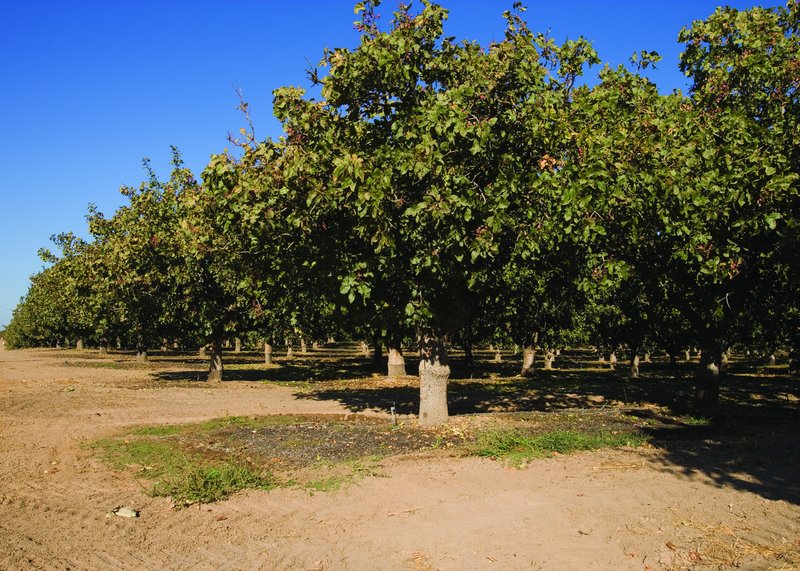
Estimates for the 2026 crop range from 600m to 800m lb, "although many market participants consider the upper end increasingly unlikely", Expana said. With the carryover, that gives handlers at most 821m lb to 1.02bn lb to sell in 2026/27, less than the 1.09bn lb shipped in 2024/25, the last light year.
That ceiling assumes nothing is left in store when the season ends, and it comes before shrinkage, the weight lost in processing. The committee set this at 12 per cent of last year's open in-shell receipts, or 156m lb.
If domestic shipments hold at last season's 345.6m lb, exports would have to drop to between 475m and 675m lb from 951.9m lb. At a 700m lb crop, the level later trade estimates have moved towards, the cut is about 40 per cent.
"No official industry estimate has been published," Expana reiterated in late August.
Jeff Nichols of Nichols Farms, a California pistachio company, put the crop "down at least 50 percent from last year's near record yield" when his harvest began on 11 August, FreshPlaza reported. "We are doing our best to navigate the shortage thoughtfully to ensure customers receive fair supply of products," he said.
HEAT AT POLLINATION
The losses trace back to a spell of heat in mid-March that county officials say struck during pollination. In Kern County, at the southern end of California's San Joaquin Valley, a survey found an approximate 56 per cent loss in pistachio production, worth just over $395mn, Bakersfield broadcaster KBAK reported on 19 August.
The county has asked the state to seek a disaster declaration, KBAK said.
The heat "really disrupted the pollination. So it's basically considered a failed pollination," said Cerise Montanio, Kern County's assistant agricultural commissioner.
Handlers sold hard into the end of the year. August exports, with kernels converted, were up more than 80 per cent on a year earlier at 59.3m lb.
"Market participants reported limited trading activity toward the end of the crop year as uncertainty continued over the size of the incoming 2026/27 off-year crop. Sellers have offered limited old-crop inventories, while prices have remained firm," Expana said. Sellers are expected to begin exploring new-crop contracts in October.
Export prices were already rising before the size of the crop came into question. US in-shell pistachio exports averaged $9.01 a kilogram in July, the highest monthly figure since June 2020, according to US Census Bureau data accessed via Cropli.
Shelled exports averaged $14.74 a kilogram from September to July, up 29 per cent on the 2024/25 average. Wholesale prices are likely to rise by 25 to 30 per cent, FreshPlaza reported in August.
ASIA, MIDDLE EAST DROVE EXPORT GROWTH
Last season's export growth went mainly to Asia and the Middle East.
Vietnam took 134.7m lb, up from 52.5m lb, to become the largest single destination, and Hong Kong nearly eight times its previous volume, while direct shipments to China fell to 34.0m lb from 153.3m lb, according to the committee's destination tables, which do not convert kernels.
Turkey, where the 2025 crop fell by nearly 70 per cent according to the US Department of Agriculture, more than doubled its purchases to 67.9m lb.
"Due to ongoing shipping challenges in the Middle East, we have eliminated all spot shipments to that region for now," Nichols said in August.
Shipments to Europe rose 22.7 per cent to 340.7m lb. The US supplied 99.2 per cent of the in-shell pistachios the EU imported from outside the bloc from January to July, up from 79.3 per cent in 2021, as Iranian supply all but disappeared, according to Eurostat data accessed via Cropli.
Since 1 July, Regulation (EU) 2026/1455 has opened a duty-free quota of 500,000 tonnes for US tree nuts that runs to the end of 2029.
The USDA's Madrid office nonetheless forecasts EU pistachio imports in 2026/27 at about 397m lb (180,000 tonnes), barely changed on the year, in its annual tree nuts report published on 16 September.
In Iran, the other large exporter, the crop will fall to 118,000 tonnes this year from 225,000, the Iran Pistachio Association said in early September, according to the Spanish newspaper La Tribuna de Albacete.
The conflict between Iran and the US that began in February has also made it harder for Iranian pistachios to reach the world market, because their natural outlet, the Strait of Hormuz, is blocked, the paper said. It also cited the International Nut and Dried Fruit Council as putting the world crop 34.6 per cent lower.
The USDA's New Delhi office, citing "low carryover stocks in the U.S." and supply disruptions in Iran, said on 10 September that "Indian buyers may need to anticipate these shortfalls and proactively adjust import timing and volumes".
The USDA publishes its next world tree nuts outlook, the first since February, on 29 October.

